comfort women
Over the course of the last decade, we’ve seen a fantastic selection of work on a huge variety of different conflicts and topics related to them. Below you will find a selection of pieces entered into our international competitions, by young people from around the world. This mini series is a good starting point when considering the many different ways conflict can affect people’s lives. We hope you will dive deeper into many of the topics and learn more.
Please be aware that the information below touches on topics related to war, conflict and its effects. It may therefore not be appropriate for all audiences.

COMFORT WOMEN
'A euphemism for women who provided sexual services to Japanese Imperial Army troops during Japan's militaristic period that ended with World War II and who generally lived under conditions of sexual slavery.'
Britannica.com
how war misplaced my youth
- jun hee (14-16, USA)

ARTIST'S STATEMENT
A Korean organization who tries to help victims of sexual slavery from the Japanese soldiers during World War II, named "House of Sharing" informed me about this competition. I wanted to pay tribute to the "comfort ladies" and the statue represented by them.

an unfinished story
- eunseo (14-16, south korea)
ARTIST'S STATEMENT
My work is based on the theme of Japanese Military Sexual Slavery that occurred during the war between Korea and Japan. In Korea, rallies are held every Wednesday in front of the Japanese Embassy. This is to face Japan, who denies their atrocities and tries to make them look like they never happened. Victims had to spend countless days in pain after that, but now they are working as human rights activists who give comfort and hope to women victims of sexual assault around the world. The butterflies and flowers which are a symbol of the victims show that they are trying to overcome the painful memories and gain hope . They continue to fight back, keeping their place. I tried to express the victims of Japanese Military Sexual Slavery continuing to walk toward a bright future without giving in to despair, leaving clear footprints of their actions behind. Those footprints are the victims' will to make Japan's atrocities be remembered in history, and a determination to move forward, not staying in the past.
just a warm hug
- DAMI
(16-18, USA)
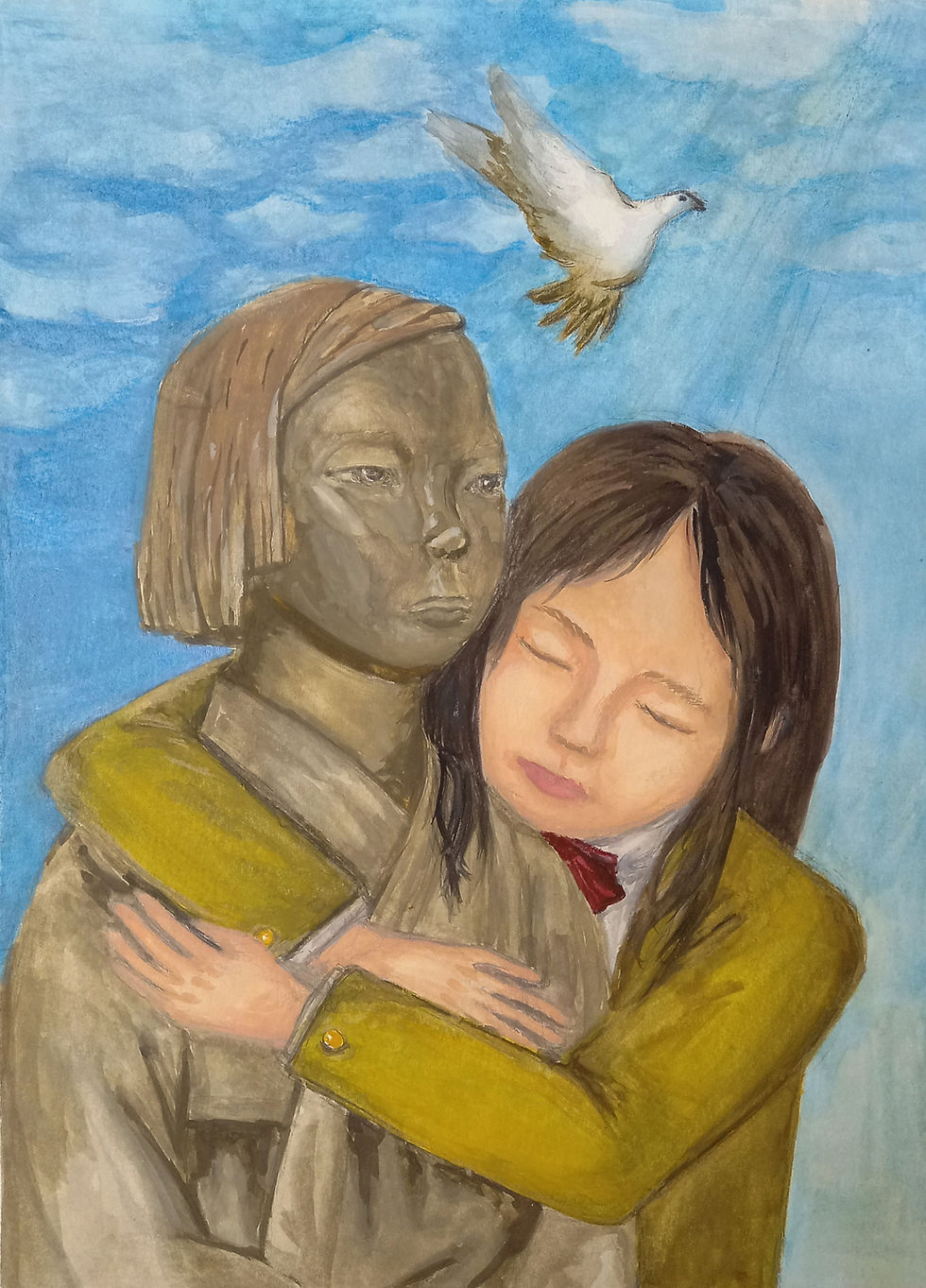
ARTIST'S STATEMENT
To remember the victims of the comfort women system during WWII, South Korea builds statues representing the victims. In the statue, the shortly chopped hair represents how the victims were cut off from their family and homes. The bird represents peace and freedom and serves as a mean of connection between us and the victims. In my drawing, the girl hugs the statue, wishing that the victims have found peace and promising that she will never forget.

shattered youth
- Yejin (14-16, USA)
ARTIST'S STATEMENT
“Shattered Youth” is a drawing about the “comfort women,” girls and women taken by force to provide sexual service during World War II to Japanese Imperial Army. Through my work, I wanted to show the rights, freedom, and youth of many girls and women that were “shattered” and broken as they were locked up, in their most beautiful time of their life, and tortured in the stations.
broken wings
- hejin (16-18, kuwait)

ARTIST'S STATEMENT
The unheard voices that I wanted to represent in my artwork are the unheard voices of young girls from the past to the present. During the Japanese occupation of Korea in WW2, nearly 20,000 women, mostly teenage girls, were forced to become sexual slaves by the Japanese military. Last year, online sexual exploitation crimes that mainly targeted young teenage girls were revealed as the “n-th room case.” Over 260,000 users paid, threatened, and even committed murder in the chatroom. Young girls have easily become victims and their voices are still unheard by this world. It is time to make their voices heard.

after the war
- Tianxao (16-18, China)
ARTIST'S STATEMENT
The conflict I want to represent is the Chinese War of Resistance against Japanese Aggression. The people in the picture are all dressed in Chinese costumes or military uniforms of that time. The work is a family portrait after war. People in black and white died, leaving only the youngest child alive. The two men on the right have blood stains mainly on their upper body, implying that they were shot dead in the war.
The woman on the left, clothes are ragged and stained with blood, they represent the women who were forced to become comfort women and who died. The old man sitting there, without blood on his body but without a leg, represents the people who were injured and died in the war. I erased the faces of the dead because I wanted them to represent all the people who died in the war, not just this family.
tears became flowers
- kristine (16-18, South Korea)

ARTIST'S STATEMENT
Comfort women are those who were forcibly taken or lured to satisfy the sexual desires of soldiers in the 1930s and 1940s. At that time, they were only teenagers. With an estimated 200,000 victims, only 14 of them are still alive out of 238 victims who are officially certified by the South Korean government. They lived their entire lives with horrendous memories that could not be compensated. However, instead of burying themselves in the memories of suffering, they actively and courageously shared their traumas with the world and carried out various anti-war activities. The tears of pain they had dropped out became a river and bloomed as admirable flowers. The river they made is awakening us today, and the flowers they bloomed are diffusing the fragrance of peace against the war.
An elderly woman in the park
Keeps her head down as she drearily sweeps the floor
After a tiring day she returns to her house
A slum, all alone in the dark crowded space
The permanent bruises from the beatings of the Japanese soldiers
The lost childhood after the coercion into slavery
The stolen freedom as a captive in a foreign country
The irreversible trauma of being a comfort woman.
The end of gunshots, the end of war
The continued shame, the continued pain
Living as a nameless outcast
By her neighbors and the enemy
A glimpse of hope
The ray of light shone through the barred windows
Turns into a series of camera flashes
In a conference room filled with reporters
“I am Kim Hak-soon, a former 'Comfort Woman',
and I am not the one who should be ashamed.”
Her name as living evidence
Her body as a battlefield
A fearless pebble thrown into a calm pond
Breaking the silence of the Japanese atrocities
Causing a ripple effect that inspired other victims to stand up
Making her story as a weapon to drive changes in the world
A lotus flower
Rises from mud without stain
Blooms at every dawn
And retires to the murky water each dusk
Though always stepped back into the dark
They will rise again
Fighting for their justice
Reborn with more strength and resilience
Lotus flower
- JIIN (14-16, USA)
CONTEXT
Jiin's poem tells the story of Kim Hak-soon testifying in 1991 after her experiences as a comfort woman. This broke fifty years of silence, creating a platform for survivors across Asia to speak up and call for justice. Kim Hak-soon's courage not only encouraged other comfort women survivors to speak up, but also women across the world who had experienced rape and violence. Japan's efforts at reparations have been limited, meaning nearly eighty years on, the victims still haven't got justice and reparation, many of whom have now passed away. Although there has been projects to honour the victims such as the Statue of Peace, the Japanese government have still failed to take proper accountability and make full reparations to individuals.
the silence of comfort women
- Ye-un (16-18, USA)

POEM DESCRIPTION
‘Comfort women’ refers to women who were victimized through sexual slavery by Imperial Japan during World War II.
Adolescent girls were abducted to ‘comfort stations’ where sexual abuse and unwanted intercourse were coerced. Loss of virginity was used against them to keep them silent. They were murdered when pregnant or attempted to escape, taking away their lives as well as their attempt to voice out their assault. Even after the war, comfort women were threatened, brainwashed, and even blamed for their own sexual disorderly conduct. Once again, the horrified and demoralized girls had to remain silent out of false guilt and fear. The monstrosity of this event reminded me of a marionette puppet, being manipulated and forced of what to do. It reminded me of their unheard voices, some not having found justice up to this day. It reminded me of the brutality of war, the struggle to live in those times.
Thank you to our supporters: